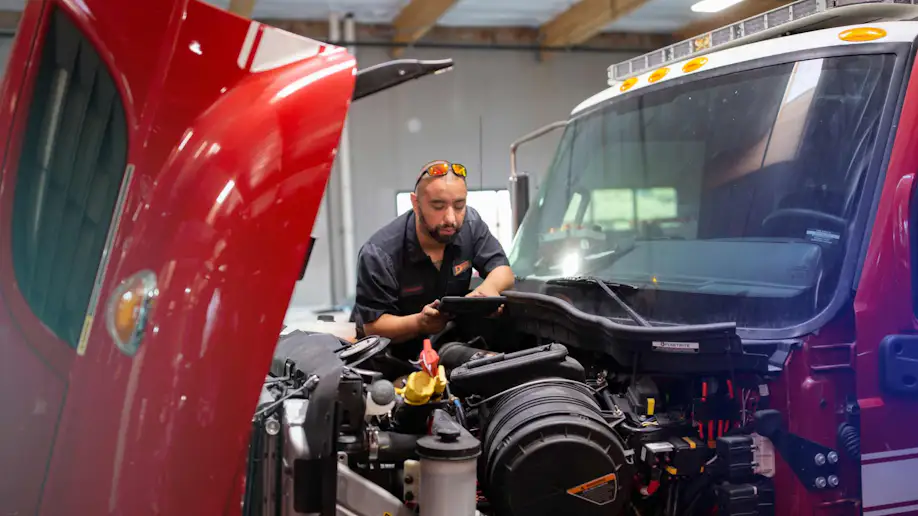
A truck or trailer sitting in your bay isn't just a repair. It's a driver with nowhere to go and a customer counting the hours until they're back on the highway. In on-highway truck and trailer repair, uptime isn't a nice-to-have. It's the whole business.
Here's what's actually working for shops that keep trucks and trailers moving, and keep customers coming back.
Preventive maintenance is still the whole game
Every experienced HD shop owner knows this: a $200 PM inspection beats a $12,000 roadside breakdown. The shops that build a steady, repeat customer base are the ones that make PM scheduling boring and reliable, for both trucks and trailers.
That looks like recurring inspection appointments set on a fixed interval, inspection templates built around what a specific truck or trailer actually needs, and unit numbers baked into the naming convention so nobody's guessing which rig is on the schedule.
Digital inspections are doing double duty
A digital vehicle inspection report isn't just a compliance checkbox anymore. It's the shop's best defense when a customer or a DOT auditor asks "prove it." Photos, timestamps, and a documented repair trail turn a routine PMI into evidence the work happened, and happened right, on both trucks and trailers.
Repair history turns into a real number
Shops that track cost by unit, broken down by labor, parts, and fees on every invoice, give owners and repeat commercial customers something most shops can't: a real answer to "what is this truck actually costing us." That history, built job by job, turns a pile of invoices into a maintenance record a customer can actually plan around.
Consistency matters more with more than one bay
For shops running multiple locations, the same PM schedule, the same inspection template, and the same cost categories need to work the same way at every site. A customer bringing a trailer to your second location should get the same experience, the same history lookup, and the same documentation as they would at your original shop.
Who this is really for
Most of the customers walking through the door are independent owner-operators and regional trucking companies bringing in their own trucks and trailers, not a fleet manager overseeing hundreds of units. Every so often a fleet account shows up too, and the same PM discipline and documentation that wins repeat business from an owner-operator works just as well there.
The bigger shift
None of this is really about software. It's about treating every truck and trailer that comes through the bay as a relationship, not a one-time repair. The shops that build for that, with real PM discipline, documented inspections, and consistent processes across every location, are the ones customers keep coming back to.
Have questions about how Shopmonkey supports PM scheduling, digital inspections, or multi-location consistency? Reach out to your account team, or .